
Paper Pilot
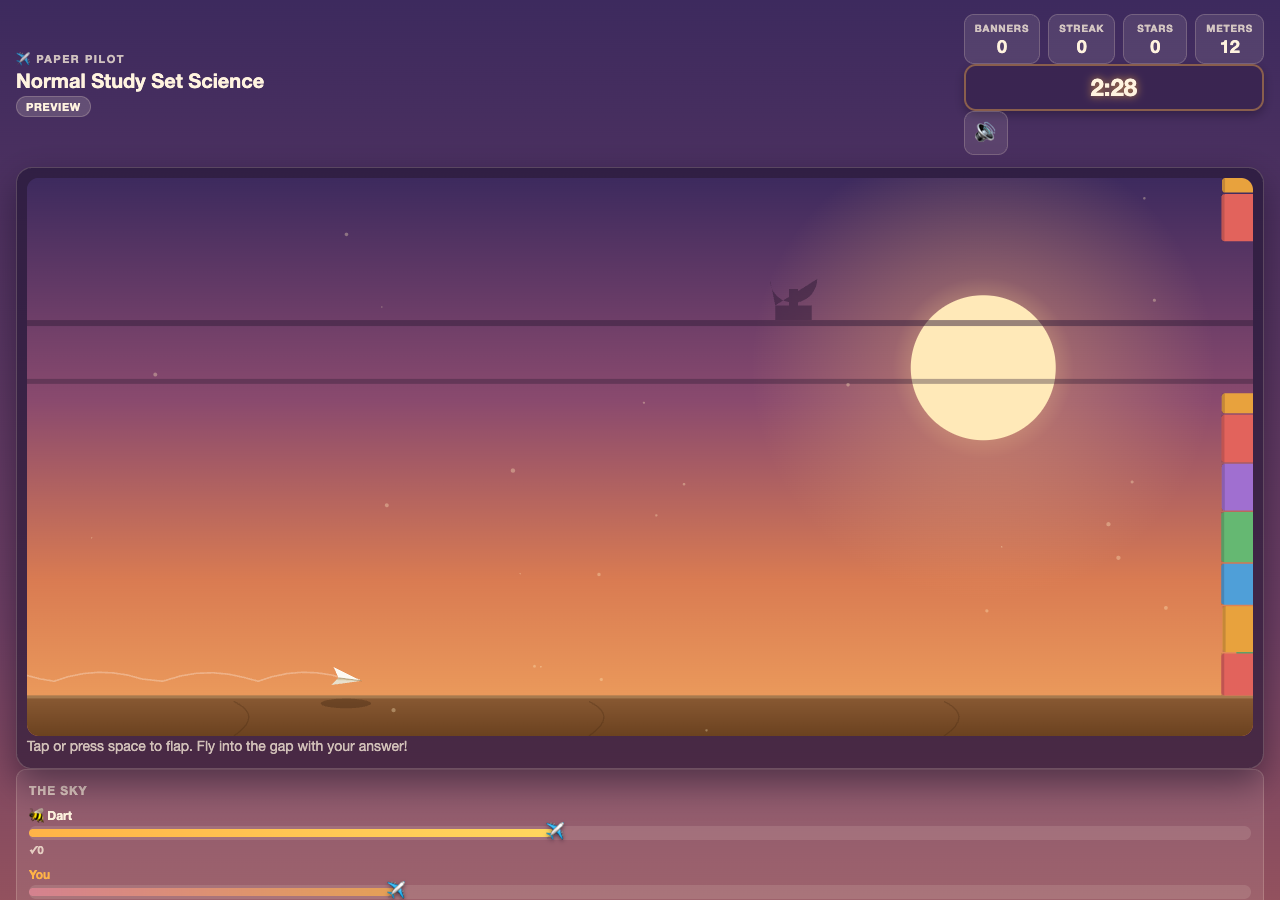 Paper Pilot is a flying review race. Students keep a paper plane in the air and steer it through the opening marked with the answer that matches the current clue.
A correct route produces an updraft and keeps the flight moving smoothly. A wrong route crumples and slows the plane, but the student can continue and recover.
Before you add Paper Pilot
- Select one Study Set or Question Set, with up to 12 source items.
- Choose a flight length, pace, and question time that match your students' age and device.
- Keep answer text short enough to read on the flight banners.
- Let students practise tapping or pressing the space bar to control altitude.
How students play
- Tap the screen or press the space bar to flap the plane upward.
- Read the clue and the answers displayed at the approaching opening.
- Adjust the plane's height and fly through the gap containing the correct answer.
- A correct answer gives an updraft. A wrong answer slows the plane before the next question.
- Continue through as many correct gates as possible before the flight ends.
Classroom multiplayer
In Deck.Toys Classroom, students fly in the same sky under one shared clock. They can see the live race while answering their own gates.
The teacher view shows progress and standings. Ranking compares correct answers first, then fewer wrong answers and distance travelled. The result therefore remains centred on learning even when some students are more experienced with the flight controls.
Challenge mode
In Challenge mode, two students fly live against one another. Both receive equivalent Study Set questions and can follow the opponent's progress through the course.
More correct answers wins. If accuracy is equal, fewer wrong answers and greater distance are used to decide the flight.
Single Player
In Single Player, the student flies with computer pilots and works through the questions independently. This mode is helpful for learning the flap rhythm before a class race.
Solo Arcade
After completing the deck, a student can open Paper Pilot from Arcade Games in Student's View, if the teacher allows Arcade play and the student has Arcade time. Solo Arcade uses the Single Player flight with computer pilots and a compatible completed Study Set or Question Set.
Teacher tips
- Use a gentler pace for the first play.
- Remind students to read the answers early, before the plane reaches the opening.
- Separate control practice from assessment if some students are unfamiliar with tap-to-fly games.
- Use the leaderboard's correct-answer count as the main learning measure.